
No signal says this page needs attention.
Pulse
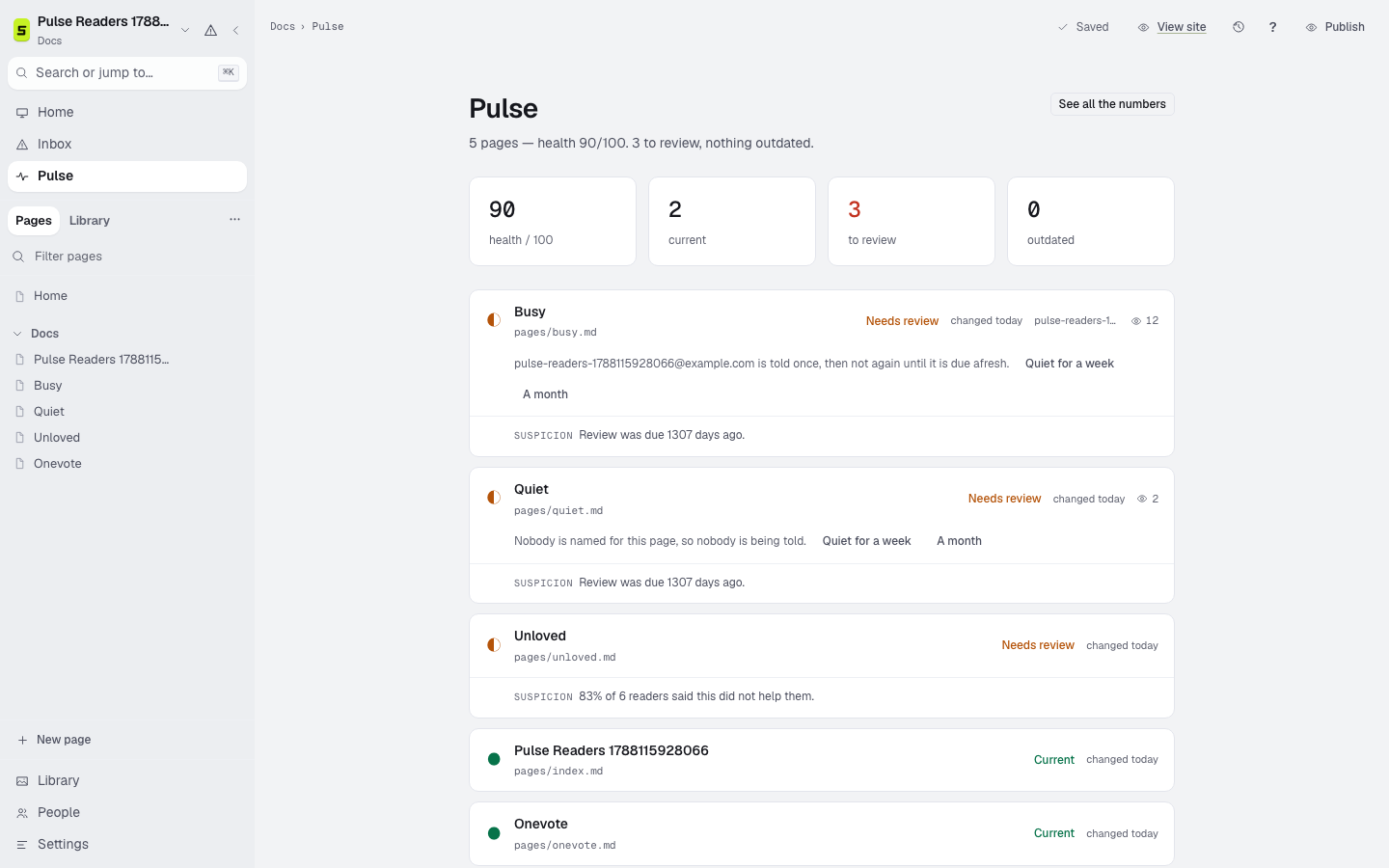
Know what needs attention. Know why.
Pulse turns product change, review policy, and reader evidence into a documentation queue your team can trust.
Three honest states
Age is a clue. Evidence is an answer.
A page does not become wrong because a calendar moved. Pulse separates “somebody should check this” from “we can point to what broke.”
Age, feedback, or a product signal gives a person a reason to check.
Evidence points to something wrong, such as a dead link or breaking API change.
Signals, not mystery scores
Every finding carries its reason.
The score only sorts the queue. The useful part is the evidence a writer can inspect, confirm, or act on.
Review schedules
Each page can say how often it should be checked and who owns it.
Git history
A quiet page without a review policy can surface before it disappears from memory.
OpenAPI changes
Breaking and additive API changes map back to the pages that describe them.
Link and navigation checks
Dead destinations and pages outside the navigation become specific findings.
Reader feedback
Repeated “not helpful” answers become a review signal, not an automatic verdict.
Reader reach
Within the same state, pages seen by more people rise so impact guides the order.
The maintenance loop
From signal to a reviewed change.
Pulse adds a trigger and the context. Your normal draft, review, and publish controls stay in charge.
- 01Detect
A product or reader signal reaches the page.
- 02Explain
Pulse names what changed and why it matters.
- 03Review
A writer confirms, fixes, or dismisses the finding.
- 04Publish
The reviewed draft becomes the answer readers receive.
Pulse FAQ
The useful details.
Does an old page automatically become outdated?
No. Age is a reason to review a page, not proof that it is wrong. Pulse only uses the outdated state when it can point to evidence, such as a dead link or a breaking API change that affects the page.
What signals does Pulse use?
Pulse combines page review schedules, Git history, link and navigation checks, OpenAPI changes, and reader feedback. Each finding names the signal behind it so a writer can decide what to do.
Does Pulse publish changes automatically?
No. Pulse identifies documentation that may need work and keeps the evidence with the finding. Drafting and publishing remain reviewable actions with normal workspace permissions.
How should a team use the Pulse queue?
Start with pages that have direct evidence and many readers, then review pages with overdue schedules or weaker signals. Confirm accurate pages as reviewed and fix outdated pages through the normal draft and publish workflow.
Start with the docs you already have